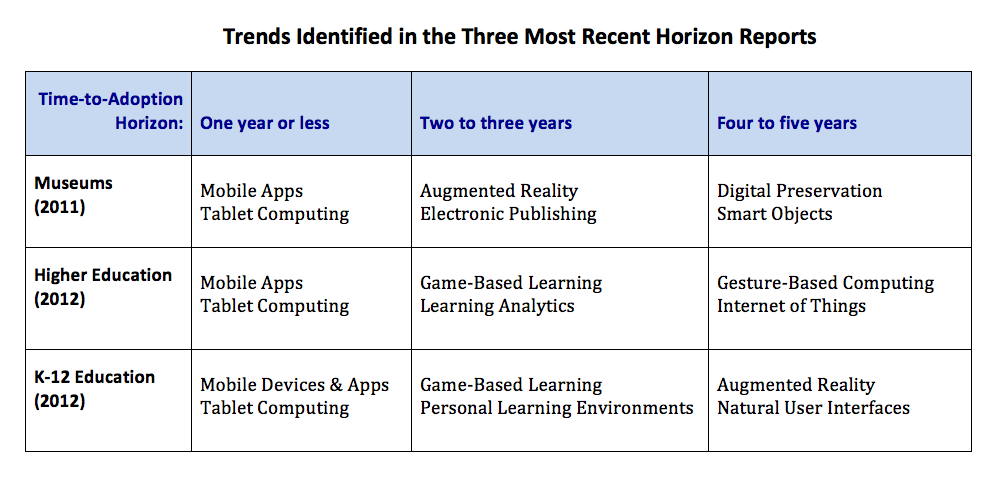
Last month, I kicked off a series of posts about museums and emerging technologies, and specifically the actual and potential interplay of technologies across educational sectors (K-12, museums, and higher ed)—and how museums might make the most of these intersections. In this post I’m going to consider augmented reality—a technology the New Media Consortium forecasts will be more widely adopted in museum education and interpretation within the next couple years, and within K-12 education within four to five years.
The NMC’s 2011 Horizon Report for museums explains augmented reality:
Augmented reality applications can either be marker- based, which means that the camera must perceive a specific visual cue in order for the software to call up the correct information, or markerless. Markerless applications use positional data, such as a mobile’s GPS and compass, or image recognition, where input to the camera is compared against a library of images to find a match. Markerless applications have wider applicability since they function anywhere without the need for special labeling or supplemental reference points. Layar (go.nmc.org/rfomi) has been a leader in this space with augmented reality applications for the Android and iPhone platforms. Layar Vision is a markerless application of AR that makes it easy to develop apps that can recognize real world objects and overlay information on top of them.
Augmented Reality is already in some museums
Museums are pretty far ahead of their K-16 colleagues in implementing this version of augmented reality. Some examples:
- Archeoguide was developed ca. 2000 as an AR platform that can be deployed at any cultural heritage site.
- The Louvre used AR to add virtual layers of information to pieces of Islamic Art. (You can read a report on that experiment’s technology and implementation.)
- The Museum of London offers the Streetmuseum app, which allows users to glimpse what the spot where they’re standing in London might have looked like 40 to 400 years earlier.
- The Science Museum in London is currently using AR technology in its exhibit Making of the Modern World. Molly Oswaks describes the experience:
Once downloaded, you need only point your phone at a targeted marker for [James] May to appear in all his three-dimensional glory on the screen of your smartphone or tablet. Your position in relation to the marker directly effects Mr. May’s. So, if you were to walk 180 degree around it, you would see the opposite of Mr. May’s body. Through nine installments in the gallery, he will talk to you and move just as if he were there in the flesh, your own diminutive downloadable docent!
You can download the markers for the exhibit (PDF) to watch May’s performance from anywhere in the world.
- An AR experience at the Getty uses a printable marker and a webcam to let visitors view its Augsburg Display Cabinet in 3D, from multiple angles:
- Weng et. al. published an article about the utility of different AR platforms for museums, and in particular for reproducing or providing additional information about artifacts.
- The Stedelijk Museum offers ARtours. Read about their latest experiments–they’re doing some really cool stuff with making otherwise invisible art visible.
- Several months ago, Margaret Schavemaker wrote a round-up of AR in museums, including projects at the Stedelijk (especially Artotheque) and the Netherlands Architecture Institute. (Read more about these projects at Museums and the Web.)
- The Petrie Museum is using AR to project ancient artifacts onto a map of Egypt.
- In 2010, the San Diego Museum of Art collaborated on an augmented reality experience for fourth-grade students.
Possibilities
One of the most exciting museum AR projects to date didn’t originate with the museum itself. Rather, two artists made a guerrilla art show at the Museum of Modern Art in New York City, superimposing new artwork onto the walls of MoMA’s galleries through Layar, and even adding an additional virtual floor onto the museum to accommodate the new pieces.
The HistoryPin app draws on HistoryPin’s crowdsourced project to put historical photos on the map. Using the app, you can superimpose historical photos onto the present-day landscape. History museums and archives could use this simple AR platform to share their collections. Each photo that your institution adds to the HistoryPin map includes a link to your institution’s HistoryPin “channel,” where you can talk up your museum, its exhibits, and its collections. (Check out the U.S. National Archives channel for a great use of this platform.) You can also create tours, as the National Archives has done with the civil rights-era March on Washington. (You might also check out Tagwhat, a similar app that allows people to build “interactive stories” that include photos and video.)
These AR applications are targeted largely at adults, but that doesn’t mean we have to leave kids out of the fun. I’m a fan of traditional sand-and-water tables, but this use of the Kinect platform at UC Davis is pretty damn cool. Imagine all the ways science centers might deploy this technology–what about demonstrating the possible shifts of rivers, oceans, lakes, and terrain due to climate change?
Deploying the technology in your museum
I frequently hear museum administrators say they can’t adopt these technologies because their staff doesn’t have the expertise—or the time to develop that expertise. And I get that–we’re all very busy trying to stay afloat in an underfunded cultural sector. However, just because we lack the time or expertise doesn’t mean we can’t bring someone on board who either has that expertise or–even better–wants to acquire it.
My solution: find a student intern who wants to learn about some aspect of museums, and then encourage her to find new applications for these technologies in the department in which she’s interning.
So, for example, you can hire a collections intern and immerse her in conservation work—by which I mean you both guide her through the process of conserving an artifact or a small collection of artifacts, but also impress on her the broader contours of, and challenges facing, the field. You might emphasize that some objects are too fragile or unstable to be put on exhibit, lament that only a small portion of the museum’s collection will ever be displayed, or express visitors’ frustrations that they can’t see the back of some of the textiles currently on exhibit. You would then challenge the student to use augmented reality technology to make the collections more accessible to visitors. Depending on the length of the internship, you could either have the student actually deploy a beta version of your AR project or have her write a white paper on the various AR technologies that might reasonably be used by the museum, recommend one, and then outline how to deploy an AR project for the next intern. Alternately, depending on the student’s interests, you could ask the student to research opportunities for grants, and then draft a grant proposal.
It’s win-win: Your intern gets a sense of collections work and new technologies, your museum learns about how it might deploy AR, and your intern has a project–either an AR project, white paper, or grant proposal–to show to future employers.
I’m putting this into practice myself in the fall, when undergraduate and graduate students in my new Digital History course will research AR platforms and create a walking tour of downtown Boise that uses AR to give visitors a glimpse of the historic city. (I’ll let you know how that goes.)
One caution
Of course, it’s easy to get caught up in the oooh! shiny! factor of new technologies, and AR implementation definitely presents such a peril. If we’re not careful, it could become just another gimmick instead of truly augmented educational programs and projects. Margaret Schavemaker points out that it’s important to foreground museum visitors’ authentic encounters:
Of course one can denounce “paratouring” — or, in terms of AR, “pARatouring” — as a distraction from what the tour is really about, namely, mediating knowledge and enhancing visitor experience both inside and outside the museum. This is a risk, and we should take care that it does not obstruct the actual encounter with the museum, collection or exhibition.
Will your museum try augmented reality?
As you can see by some of the examples—particularly those platforms that allow anyone to contribute, such as Tagwhat and HistoryPin—museums can test the waters of augmented reality without breaking the bank. Whether you budget a bit of time for your staff to upload photos to HistoryPin or hire an intern to explore Layar or Aurasma, your institution need not invest a lot of money into exploring this virtual frontier.
How might your institution use AR?
If you want to read about additional opportunities for museums to deploy AR, you can download Areti Damala’s dissertation, “Interaction Design and Evaluation of Mobile Guides for the Museum Visit: A Case Study in Multimedia and Mobile Augmented Reality.” (PDF)