Here’s one example of why you might want to hire me to help organize your exhibition, programming, or other content. If you call me in advance of your opening, I can help you catch unfortunate adjacencies like this one:
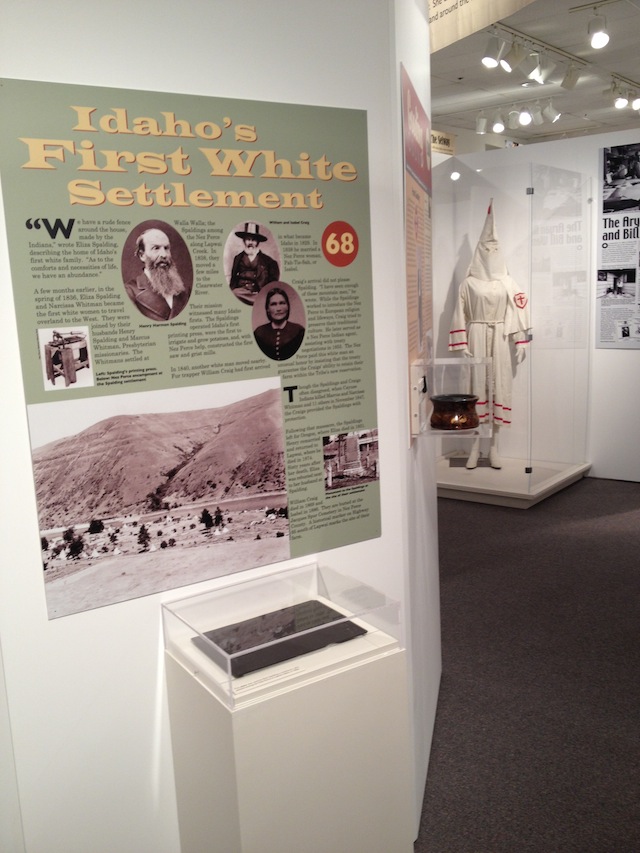
Here’s one example of why you might want to hire me to help organize your exhibition, programming, or other content. If you call me in advance of your opening, I can help you catch unfortunate adjacencies like this one:
While researching local history, one of my students recently came across an old newspaper article she thought I’d find amusing. Titled “Old Scenes Take Form At Museum,” it was a piece on a new exhibit opening in the state history museum.
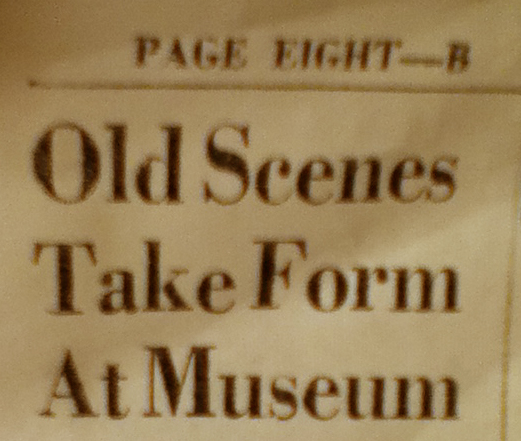
I do indeed find museum history interesting, so I was eager to see how the exhibit was described, what motivated the museum to put it up, and to compare it with the exhibits in the museum today so that I can get a better sense of how the museum’s exhibition philosophies and priorities have shifted.
You can see where this is going, right?
The exhibit featured in the newspaper is still up today, and from the description in the article, it appears it hasn’t changed at all.
The newspaper article was published in the early 1960s.
My point in writing this post is not to shame or embarrass the museum in question. (It certainly isn’t alone in having permanent exhibits that are, well, permanent.) As with many state history programs—and, I’m guessing, like many such programs in politically conservative states, where education tends not to be funded as fully as it might be elsewhere—it’s clear even to the casual visitor that the museum doesn’t have the money to mount new exhibits on a regular basis.
Still, it’s important to point out the liabilities of such an approach to exhibitions to underscore the importance of keeping up-to-date with museum theory and practice.
First, it’s not good when visitors say about your museum—as did the students, aged 20-50, I took to this museum last month—”It hasn’t changed since I was a kid.” The number of visitors who appreciate the nostalgia factor is likely to be far smaller than those who would like to see a new exhibit. Late last year, Reach Advisors delved into their databases to determine what visitors’ attitudes are to changing exhibits—and whether these attitudes differ among museum members, frequent visitors, and occasional visitors. Among their findings:
Changing exhibitions does not necessarily mean huge costs, though costs are certainly a factor. Of the written-in comments we examined asking for more changing exhibitions, none referred to what we call “blockbuster” exhibitions. Some suggested small changes to liven things up. Change might be a “science in the news” area, which changes on a weekly basis but would not necessarily meet design standards for a longer-lasting exhibition. Change can be delving into the permanent collection and highlighting an artist, or a local history topic, and featuring those items through a new lens (a tactic deployed by many museums during these rough economic times). Change doesn’t mean an expensive line item, and it doesn’t mean changing over the entire museum every six weeks, though it does mean a commitment of some funds and considerable time.
One of the most commonly asked questions on humanities and arts grant applications today seems to be some variation of, “What’s innovative about your project?” A museum might be able to find a grant writer who could answer that question relatively persuasively about a proposed exhibition redevelopment, but if I were on a grant proposal review committee—and I have been—I would be looking for evidence that the museum has dabbled in whatever brand of innovation its staff wishes to implement. In the case of this particular museum, if I saw that most of the exhibits were 30, 40, or 50 years old, I would wonder about the museum’s capacity to implement best practices in museum education and exhibition—simply because I don’t see many signs in the current exhibits that the museum is even interested in experimenting with, say, interactivity or with exhibit panels of fewer than 300 to 500 words.
Let’s say this museum knows it should implement a new degree of interactivity but it hasn’t. Because authentic artifacts are the traditional history museum’s stock-in-trade, incorporating interactivity may at first seem a challenge because visitors can’t touch the artifacts the way they can interact with objects and manipulatives in a science center or children’s museum. Furthermore, if the exhibition development and education staff of a history museum hasn’t been provided quality opportunities for professional development—and I don’t know if that’s the case with this particular museum, but the museum’s exhibits do not reflect the at least last 20 years or so of theory and practice—then they might not be able to think beyond expensive replicas and the sometimes complex “recipes” for fabrication designed by science centers like the Exploratorium. Once we can force ourselves to think beyond video kiosks, replicas, and dynamic science interactives, we find many possible baby steps toward interactivity or visitor participation. It’s easy to add a simple paper-and-pen or token-based polling system for visitors, create laminated cards or brochures that offer alternative tours through the museum based on individual visitors’ interests, or affix QR codes to exhibit labels to direct visitors to more in-depth content on the museum’s website or to additional photographs of the object from angles that aren’t visible to the visitor.
Interactivity can be simple and inexpensive to integrate into an exhibit, and much information is available freely online about how to successfully include interactive components in an exhibit. There’s no longer any good reason a museum hasn’t adopted such techniques, and it doesn’t make sense for a museum to ask for funding for a new, innovatively interactive exhibition if it hasn’t shown interest or capacity in more basic interactive techniques.
Although museum professionals know that in most museums only a small percentage of artifacts ever see the exhibition floor, my sense is that few donors to local history museums understand their treasures likely will remain in storage in perpetuity. Donors who wish to see their gifts on display during their lifetimes may be dissuaded by decades-old exhibits or by temporary exhibits not drawn from the museum’s collection. In addition, speaking for myself, I’d be unlikely to donate my family’s beloved heirlooms to a museum if the institution lacked the creativity and wherewithal to interpret artifacts in ways that challenge visitors to think critically and creatively.
Let’s consider a few ways to update this exhibit relatively inexpensively and thus gain some respect in the eyes of visitors, current and prospective donors, and even funders.
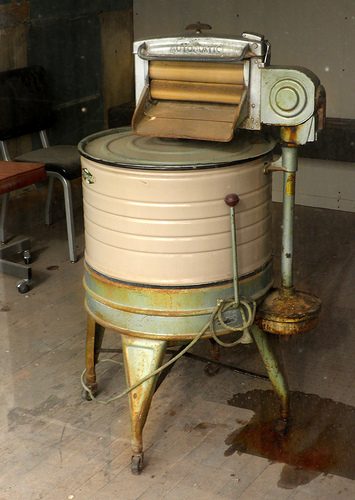
A wringer washer in Wyoming. Image by arbyreed, and used under a Creative Commons license.
First, a description. The “old scenes” mentioned in the newspaper article comprise a kitchen and porch exhibit whose central feature appears to be laundry. I haven’t paid attention to the exhibit lately, but if memory serves, there is a wringer washer, soap containers, and some other household goods arrayed on a porch. The article describes it thus: “The porch display. . .will include an old hand-crank clothes washer, ice-box refrigerator, rocking chairs and a stack of wood.”
The exhibit depicts, in other words, a tiny slice of domestic life at the turn of the last century. My reading of it is as cute and nostalgic in a way that makes me uneasy because the woman who would be using the objects displayed in the kitchen and on the porch is absent; her labor becomes invisible. So, in this scenario, let’s find a way to make that woman and her labor visible to the visitor.
Assuming visitors can get network reception inside the museum’s building, I recommend adding multimedia content accessible via smartphone, 3G or 4G tablet, or, if the museum is equipped with public wifi, a wireless device like an iPod Touch or wifi iPad. Having such content available on devices a visitor brings with her, or even on a device that can be checked out from the front desk, means that the museum won’t need to buy, maintain, and update a bulky and expensive audio or video kiosk. This content might be accessible through a QR code or simply a URL printed at the bottom of the exhibit’s interpretive panel.
Audio content might include the voice of a woman talking about how tired she is after using all these devices or telling a story about how her curious toddler stuck his hand into the wringer when her attention was directed toward another one of her children, and she cranked the handle (audio of child screaming or crying), and the doctor had to be called to examine the child’s hand. Alternately, the printed URL might take the user to a YouTube video of someone using a hand-cranked washer:
In an underfunded museum such as this one, audio content could be created by interns who undertake research into the use of such machines, then are given free range with Audacity or another free or low-cost audio editing program. Interns also could seek out such video footage of an antique washer, such as I’ve posted above, and embed it onto mobile-friendly pages on the museum’s website. (Of course, best practice for any institution would be to include a link to a transcript of the audio for deaf visitors and a description of the video for blind visitors.)
Or we could tell a different kind of story. This is, after all, a museum with a quarter million objects in its collection, so it has plenty of artifacts it could be exhibiting. Perhaps we see the open porch at a moment of transition; it’s being enclosed to make a laundry room, and the woman has set her old hand-cranked washer and wringer out in the yard to make way for her new machine, which features an electric agitator. Audio or textual content could describe the woman’s feelings about the new machine at the moment of its arrival, as well as showcase her ambivalence a few months down the road, when she complains about constantly having to repair it, or when she expresses the belief that it’s too rough on her family’s clothes, wearing them out prematurely.
In this scenario, collections and education staff could establish a schedule whereby the laundry machines and interpretive content (text or audio) are updated every few months. Visitors could play a game, made with magnets and laminated photos of old laundry machines, in which they try to place the laundry machines in the correct chronological order.
Or, of course, we could abandon laundry altogether. It isn’t, after all, the sexiest subject. Moving away from laundry, however, doesn’t have to mean a complete (and costly) exhibit renovation. The relative openness of the porch exhibit “stage” lends itself to any number of scenes in a way that, say, the built-in cabinets and framed windows of the restored formal dining room in an adjacent exhibit do not. The museum could tell any number of stories about race, class, age, gender, leisure, and labor.
And need I mention that it’s best practice to rotate artifacts? Changing exhibits allow objects relief from light, vibration, and other damaging phenomena.
I’d love to hear your own stories of
I’m also eager to hear what solutions you’d propose to the particular challenge I’ve shared in this post. What advice would you give the museum staff?
A few months back, in my role as an assistant professor of public history, I took over the coordination of the internship program for my academic department. I’m learning very quickly why it merits a course release or two; the job calls on me to play matchmaker between internship supervisors and interns, check in with all parties occasionally, request reports from the students, and, in consultation with supervisors, assign grades at the end of the semester.
While I don’t think it’s particularly helpful in building my tenure case, it is worthwhile and important work, for three primary reasons: internships increase the skills and cultural savvy of emerging museum professionals, facilitate collaboration across institutions and organizations, and democratize knowledge.
Traditionally, both interns and mentors have recognized skills enhancement as the most obvious benefit of internships. Classroom learning only goes so far; to understand actual museum practice, one has to write an actual grant proposal, develop an exhibit under real resource constraints, coordinate the myriad details of family night programs, or stabilize crumbling ephemera.
Internships, however, offer additional benefits to the broader museum field.
Internships can dissuade as well as inspire. They can help to “weed out” students who might initially be enthusiastic about one aspect of museology (or the field more generally) but who really, for whatever reason, don’t have the interest in or aptitude for a particular kind of work. Both interns and mentors have frequently lauded this aspect of internships to me, as it can save both emerging professionals and institutions numerous headaches and heartaches.
When planned well by the hosting institutions, internships also can serve as an introduction to the culture of the field. The best interns remain aware of the conversations going on around them, and the most thoughtful institutions allow them to listen in on discussions that take place in conference rooms, hallways, and the exhibit floor. This entry into museum culture can be managed deliberately, but more likely it will be accomplished through osmosis, with the intern picking up on the major challenges facing the museum and the field, the relationship of visitor demographics to exhibition content and programming, the typical working environment of a museum, staff and administrative perspectives on donors and foundations, and the expectations the public has of nonprofit service.
Internships can allow busy staff to collaborate through a joint internship. The vast majority of interns require a good deal of instruction and supervision in the first weeks or months. Organizations can share this commitment of time and resources by co-mentoring an intern. So, for example, today I met with the director of a desperately understaffed historical museum complex, and I proposed working together on a grant-writing internship. I’ve been wanting to dig into local museum collections, both for my own research and to put together an exhibit. A grant-writing intern could work with both me and the museum to research grant opportunities for local history research, exhibition development, and digital dissemination. Perhaps I’ll get some funding for a student assistant to help with a digital humanities project arising from the research, and the museum could get funds for artifact conservation. The grant-writing intern will hone her research skills, learn about humanities funding, and develop her writing in a new genre.
Think about all the variations in which one mentor could take the lead on content knowledge and the other on skill development! Here are some possibilities:
Joint internships may allow for surprising discoveries. If not planned carefully, a joint internship could become contentious, with the intern confusing conflicting policies and practices between the two organizations. However, if the mentors articulate expectations at the outset, each organization could learn much from the other. If we approach the internship with the idea that museums can be think tanks, and we give an exceptional intern sufficient space for intellectual reflection and discussion with mentors and others in the organization, there are countless opportunities for new syntheses of philosophy and practice.
For example, imagine a collaboration between a history museum and a science center. Many smaller history museums have not yet integrated hands-on or participatory activities into their exhibits, often because they cannot allow visitors to handle artifacts and their exhibition budgets can’t support the production of replicas. (And even then, replicas might not be particularly interactive.) At the same time, many visitors have come to expect interactive elements in museums, particularly if they have brought children to the museum. The intern might be asked to answer the question, “How can our history museum’s next exhibition integrate meaningful, interactive and participatory elements that conform to current best practices in informal learning?” Perhaps the city or a neighboring town has a science center or children’s museum that boasts an exhibit developer or education specialist who has become an expert at crafting ingenius interactives on a small budget. The science center could provide the intern with background on the pedagogy of third-generation science centers, which the intern could then use to inform an exhibit showcasing the museum’s collection of medical technologies and tools. The science center could later borrow some of the museum’s historic tools to provide some historical context to its own exhibit on the human body.
I have written elsewhere how one of my core beliefs is that knowledge should be democratized—that is, it ought to be accessible to, and usable by, a broad public audience. Internships can play a major role in the democratization of knowledge by and through an institution. Let’s look at how this process works for both interns and institutions.
Internship programs can provide training that is unavailable in formal educational settings. This is particularly true if your interns live in a region, like mine, where there aren’t many museum studies programs. According to the Smithsonian’s Museum Studies Training Directory, Idaho, Montana, and Wyoming are completely devoid of such programs; Nevada offers one undergrad minor in museum studies; and Utah has one certificate in museum practice. My own institution offers a Master’s of Applied Historical Research, but it’s definitely more public history than museum studies. If a student geographically bound to Idaho by family or work is interested in curatorial practice, and especially artifact conservation, she’s going to have a difficult time finding hands-on training. The Bureau of Labor Statistics points out that
There are only a few graduate programs in museum conservation techniques in the United States. Competition for entry to these programs is keen; to qualify, a student must have a background in chemistry, archaeology or studio art, and art history, as well as work experience. For some programs, knowledge of a foreign language also is helpful.
As far as I know, there is only one curator in the largest metropolitan area in my state—and possibly in the entire state—with up-to-date skills in conserving historical artifacts; she learned on the job in part from someone who has now retired, and in part through reading widely and asking questions of far-flung colleagues. She bolstered her skills with an online certificate program from an East Coast university. Fortunately for me and our students, she is a generous soul. Her knowledge, and her willingness to mentor interns, makes it possible for interns moored to Idaho to learn crucial curatorial skills.
Internship programs can give museums even greater insight into their communities. Let’s face it: no matter how much a museum engages with its community, there’s always some demographic that has not yet reached audience saturation—or perhaps it lacks any representation within the museum’s exhibitions and programs at all. Accordingly, when we’re talking about democratizing knowledge about museums, as well as about the knowledge contained within museums, intern diversity becomes particularly beneficial. In my own community of Boise, this might mean looking beyond the typical interns—largely white, middle- and upper-working-class class students—to, say, the community of refugees, as the city is a refugee resettlement site. Think:
Internship programs can push mentors to learn new skills alongside their interns. Encouraging an intern to read in depth about the latest developments in one aspect of the field, and then discussing the intern’s findings, can expand mentors’ own understanding. Interns can help mentors build not only their knowledge, but their skills. Assigning a largely self-directed intern to create an online exhibition using Omeka; to make an argument for and sketch of the organization of a new visitor-tracking database; or to program a browser-based mobile app can be an opportunity for supervisors to stretch their own technological comfort zone.
What innovative or interesting internships have you observed or participated in? What made them work well?
Want help with your intern program or professional development plans? I can help.
I wrote this post for a more general audience at BlogHer, but the post ended up including a nice round-up of links, so I’m sharing it here as well, along with a couple of provocative questions near the end of the post.
Late last year, the American Association of Museums released a discussion paper titled Museums & Society 2034: Trends and Potential Futures. The report looked back 25 years to 1984 as it predicted what museums will look like 25 years from now. Specifically, the 20-page report examined “demographic trends, changes in the geopolitical and economic landscape, shifts in technology and communications, and the rise of new cultural expectations.”
For example, after pointing out that a larger percentage of the U.S. population will be senior citizen in 2034 than are seniors now, the report suggests museums will not only be accessible to people using walkers or wheelchairs, but will sport larger exhibit labels and will incorporate aspects of universal design as a matter of course. In another example, volatile energy prices will lead museums to
educate the public on how past societies coped and adapted to tectonic shifts in their resources. They will help society learn from history as we cope with a new era of more expensive energy, lower consumption, carbon constraint and climate change. Museums have uniformly adopted green design as a mark of excellence, leading by example and integrating green practices into operations. Some museums operate joint storage facilities designed to minimize energy costs while providing appropriate climate control. More museums establish satellite locations to serve outlying communities, reducing their audiences’ need to travel.
Some of the report’s predictions will come to pass much earlier, I hope. The eco-trends are notable, but even more relevant at this moment, I think–as I contemplate the possibility of my own job falling before the scythe of university budget cuts–is the suggestion that museums become resources for “communities with job losses reinvent themselves in the new knowledge-based economy.” Yes, please–sign me (and the rest of the giant University of California community) up! Indeed, Elaine Heumann Gurian has suggested that museums might serve some of the same functions as soup kitchens in the current downturn. (Be sure to read Marjorie Schwarzer’s reply to Gurian for some very interesting historical context.)
But in order to understand the future of museums, we first must look at their present. And it ends up that even museums aren’t at all in agreement over what constitutes a museum. As Elizabeth Merritt, director of the Center for the Future of Museums wrote today,
What is a museum? As a group, do we really have one unique element or set of characteristics that unite us as a field, while distinguishing us from other types of organizations? Are children’s museums (three quarters of which do not own or use collections) really in the same business as art museums? What about science centers? How much do museums that primarily exist to serve the general public have in common with museums like the Peabody [Museum of Natural History], where the majority of the collections serve a specialized community of researchers?
And collections are just one parameter—there are many others, some very complex and hard to characterize. For-profit museums like the International Spy Museum or the Museum of Sex look just like any other museum to their visitors, but their governance, accountability, and regulatory environment are so different that the National Standards and Best Practices for U.S. Museums don’t cover them.
No discussion of the present and future of museums would be complete without a mention of the following issues:
I think it’s awesome that women are doing so much of the thinking about and planning for the museum of the future and the future of museums. Do you think women think and talk about museums differently than do men because we experience the world in different kinds of bodies?
How do you envision the museum of the future? What do you want your experience to be in and with museums? And how–if at all–would you like to see museums involved in your community?
I’ve become quite enchanted lately with the tweets of many of the museums and related institutions I follow on Twitter. I’m a sucker for a link to a picture or video of a baby animal, even if it is an amorphous little shark pup. That said, I’ve noted some carelessness lately in the way institutions tell stories about their animals. Check out this video, for example, from the Georgia Aquarium:
Issues of animal transportation, care, and trauma aside–and I do believe aquaria on par with the Georgia Aquarium adhere to best practices in this regard–moving this one animal has expended a tremendous amount of energy. The manta ray’s carbon footprint went from zero to who knows how large.
Zoos and aquaria have two primary narratives: “We bring the world’s animals to you” and “We bring the animals here to study and save them.” Yet as visitors to these institutions finally begin to catch on to the whole giant carbon footprint = climate change = harm to animals and their environments equation, zoos and aquaria are going to have to learn to either counter narratives of wasteful transportation (a dangerous travelogue) or limit their acquisitions to local and regional species. Although the Georgia Aquarium is a spectacular institution that features local species as well as animals from around the world, I must admit I’m more sympathetic to aquaria, such as the Monterey Bay Aquarium or the Long Beach Aquarium of the Pacific, that focus on the bodies of water on which they sit, even if they be (as in the case of Long Beach) especially large ones.
“But Leslie,” you say, “the Georgia Aquarium is being transparent in celebrating its ingenuity in bringing this ray to the public. Can’t you let them tell this one story?”
Sure, one story. But then there’s this:
Same kind of story, only with a less charismatic animal and not quite such spectacular technology. I’m sure if I searched I’d find plenty of other dangerous travelogues from zoos and aquaria.
For decades zoos have been tweaking the enclosures of the animals they have on display in the hopes, among other goals, of reducing stereotypies and other unhealthy behaviors. As zoos increasingly move elephants off display because zoo environments are antithetical to elephants’ good health, thoughtful people are going to wonder if whale sharks and beluga whales really do belong in relatively small tanks (as they already wonder about displaying dolphins), what kinds of energy go into supporting them, and in what ways we’re damaging not only the animals but the environment. (Kudos, by the way, to the Cal Academy’s Steinhart Aquarium for eschewing the “crystal clear” industry standard of aquarium water in favor of a more energy efficient system that uses less electricity and water because it requires less filtering.)
These dangerous travelogues remind me of a Sea World phenomenon Susan Davis highlights in her book Spectacular Nature:
[W]ith few exceptions complexity, local connections, and controversy are missing. Sea World’s environmental messages are little different from the flat morality play of the rest of corporate environmentalism in their emphasis on individual responsibility for cleaning up litter. (150)
I don’t mean to equate our nation’s best aquaria with Sea World, but there are parallels in that the aquaria are sending mixed messages when they roll out these dangerous travelogues–by which I mean narratives and actions that are dangerous for the environment and dangerous for public relations. And it’s not just travelogues about animals coming to the aquaria that are problematic–it’s also the stories these institutions (don’t) tell about the impact of human travel (daily or otherwise) on the earth.
At the Monterey Bay Aquarium and, I’m sure, at other aquaria, visitors can pick up wallet-sized cards that help them decide whether to buy, for example, wild or farm-raised salmon. I’ve seen elsewhere cautions that people need to cut up the plastic loops that hold together six packs of soda or beer. While these certainly are steps individuals can take, they do not challenge the complicity of larger entities–nations or corporations–in the threats human activities pose to ocean life.
This brings us, of course, to corporate sponsors. When the New England Aquarium receives donations from energy companies or the World Aquarium in St. Louis accepts donations from automobile, beverage, and pharmaceutical corporations whose industries may be polluting the earth and its waters, those relationships should be made transparent. What are aquarium visitors not hearing about pharmaceuticals in our waters and the ways they threaten freshwater and marine species?

Photo of Georgia Aquarium’s manta ray by Tim Lindenbaum, and used under a Creative Commons license.
It’s nice to provide visitors with cards about which fish to eat or not eat, or postcards they can mail directly from an institution asking their local representatives to vote for a bill to form, say, a marine preserve or to fund more marine research. But at the same time, aquaria need to be telling visitors that they can do more–much more–but that doing so requires collective rather than merely individual action. Aquaria and zoos and natural history museums must learn to better harness the thoughtfulness and excitement of the one percent of visitors about which Nina Simon wrote yesterday.
And putting videos on YouTube of manta rays being flown across the country? That’s not the way to engage that one percent; it raises their hackles rather than their enthusiasm.
Although I teach in a museum studies graduate program (and wish I could do it full-time), my primary job is to help faculty become more thoughtful about teaching undergraduates at the University of California, Davis. Since I began working in the university’s Teaching Resources Center, faculty have come to me for assistance with myriad issues, but there are three that arise more frequently than others:
The first and third of these quandaries are generational ones in that in the U.S. we are educating students in an era of reduced resources, higher enrollments, and high-stakes testing in K-12. The second quandary relates intimately to the first and third.
The problem of coverage, what I have heard termed “the tyranny of content,” has of course long plagued curators and exhibition developers as well as professors. In museums it takes many forms: a desire to exhibit all the varieties of one object (e.g. butter churns, to borrow an example from Dan Spock) or to cover an immense amount of material and history in too small a hall (e.g. the Smithsonian National Museum of Natural History’s African Voices exhibition), for example.
Museums have also long had to deal with large numbers–sometimes crushing numbers–of visitors to new, blockbuster, or otherwise favored exhibitions. How to serve so many people while still giving each visitor a sense that she has had a personalized interaction with the museum content is one of the great quandaries of museum education, and we’re barely scratching the surface of this problem with some tentative experimentation with digital and/or mobile devices.
The new generation of young adults, however, presents a particular challenge to museum educators, exhibition developers, and docents. If they attended a public university in the U.S., and especially in California, these “Gen Y” “Millennials” are likely to have been a victim of what I call the factory farming of students: large lecture halls crammed with students, multiple-choice tests, and a long series of general education courses that represent to them not opportunities to explore new disciplines, but rather a series of boxes to be checked off: the writing requirement, the diversity requirement, the quantitative thinking requirement, etc. In addition, these college students and graduates came of age under No Child Left Behind, a regime of high-stakes testing that led school districts to “teach to the test” rather than engage in the student-centered learning that imbues young people with curiosity, gives them the intellectual tools and cultural literacy they need for interpreting and analyzing the world, and ensures a desire for lifelong learning. Many of these young people are thus victims of large-scale, depersonalized educational systems. Trained to memorize and regurgitate instead of interpret and create, they are not equipped to engage with museum content–and worse, they may not even be aware of their predicament.
Clearly, this generation provides an opportunity for–or, rather, is in desperate need of–visitor studies that examine how trends in our K-12 and university systems affect museumgoers’ understanding of material culture, art, hands-on science exhibits, and natural history objects. What new kinds of interpretation will we need to develop? How can we teach interpretive skills to those in galleries as well as convey content?
Based on my own experiences in the Gen Y classroom, my observation of others’ classes, and my consultations with faculty, I offer here some tentative suggestions for meeting the needs of Gen Y learners in the museum.
Provide strong orientation. By this I mean museums need to strike a balance between free-choice learning and making learning objectives painfully explicit. How this might look will vary by institution, but one place to start is with a strong framing device. One exhibition that accomplishes this well is the new mammal hall at the Smithsonian’s National Museum of Natural History. There is no clear pathway through the exhibit hall, and it’s easy for the dramatically lit trophy-quality mounts and evocative soundtrack to overwhelm the visitor with their pure spectacle. However, the museum has framed the exhibition in an orientation gallery, using this conceit:
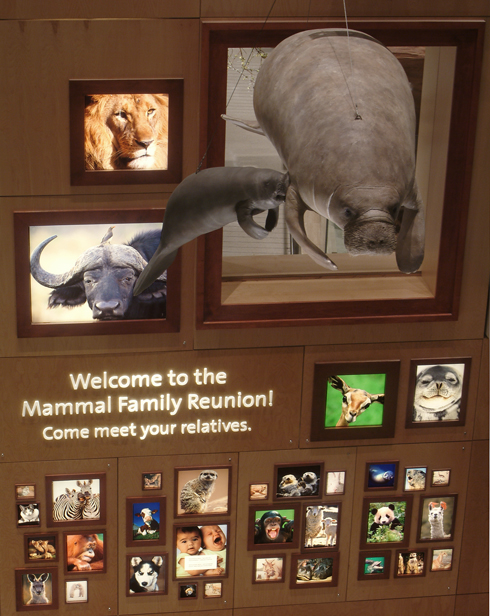
photo courtesy of the Smithsonian Institution
Visitors are welcomed to the Mammal Family Reunion and learn that mammals can be identified because they all share three basic traits: they have hair or fur, they possess specialized middle ear bones, and they produce milk for their young. Elsewhere in the exhibition, visitors learn more about mammals’ diverse environmental niches and adaptations, but the framing device is that all of these animals, despite their tremendous diversity, are from the same “family” (more precisely, the same class within the phylum chordata). Certainly there are some of you saying, “Really? That’s all people are going to take away from this exhibit? That mammals are hairy, produce milk, and have something in their ears?” To which I say:
Ideally, as the visitor walks through the mammal hall, she would be learning concepts that build upon these basics. For example, mammals all have fur or hair, but they have differing amounts of it. A jackrabbit and a sea otter have dramatically different densities of fur because they have adapted to living in very different environments. Although they descend from a common ancestor, these animals evolved in ways that allowed them to occupy, and even thrive in, a niche.
Help visitors develop analytical frameworks and interpretive skills. We see a bit of this in the example above. Visitors learn three basic facts, and then begin to make observations on their own about each fact–e.g. that mammals’ fur density differs by species. Next the visitor should be prompted to puzzle through why the fur differs. And then comes the big lesson: What are humans doing to change the environments in which these animals live? What happens when an animal evolves over tens or hundreds of thousands of years to occupy a niche that is decimated by humans in a matter of years? What are humans’ responsibilities to endangered mammals? Why might humans be more amenable to protecting mammals (AKA “charismatic megafauna”) than they are other species, and what are the advantages and liabilities of this approach to conservation? Labels, podcasts, hands-on activities, docents/explainers, and visual organizers all can contribute to this learning.
Customize streams of content. Provide interpretive tours organized around visitor interests instead of gallery space. Offer audio tours created by a variety of experts or amateur enthusiasts, including “guerrilla” audio tours. Examples from our mammal hall might be an evolution-focused podcast, a conservation-focused activity book or handout for children, or ways for visitors to send themselves the URLs of content related to the exhibition areas in which they’re most interested–e.g. polar mammals or desert creatures.
Provide content in multiple formats. The streams of content you provide must be accessible in several formats. This might mean visitors can generate e-mail messages to themselves–perhaps a series of autoresponders–to learn more post-visit, send to their mobile phone or PDA the snippets of code they need to embed customized media in their blogs or Facebook news streams, or pick up topic-specific paper handouts upon exiting the exhibition.
Offer opportunities for collaboration. Hands-on exhibitions sometimes call for cooperation among visitors, but opportunities for collaboration are rare–and it is a skill that Millennials may not have had the occasion to practice in high school or college. They do, however, excel at text-messaging and similar brief format activities. How might you use cell phones’ texting capacities, for example, in your exhibition space? Once you have Millennials contributing as individuals, you can adapt your content to move them up Nina Simon’s hierarchy of social participation.
UPDATE: Since I wrote this post, NPR has posted another segment in their Museums in the 21st Century series–and this one addresses how the culture of testing has impacted field trips for school kids.