As a follow-up to Feminist Ryan Gosling, someone has created Public History Ryan Gosling.
A sampling:
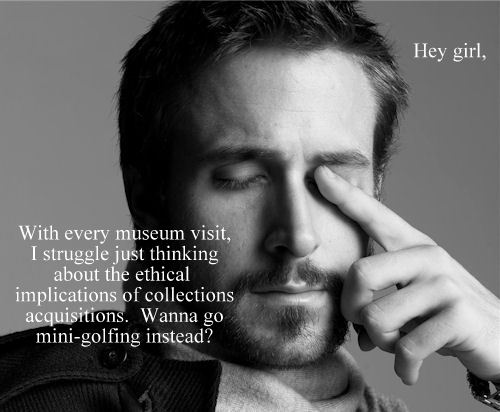
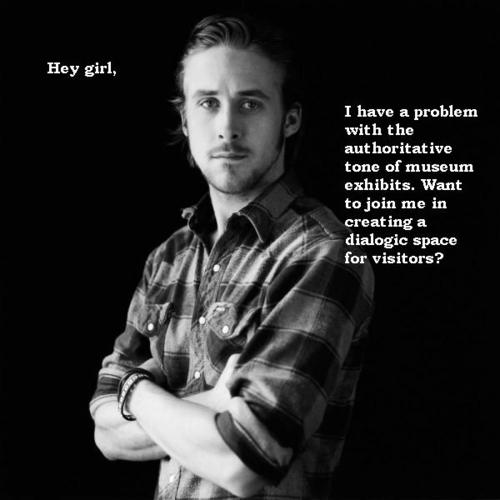
As a follow-up to Feminist Ryan Gosling, someone has created Public History Ryan Gosling.
A sampling:
I get lots of queries, both from my own undergraduates and from students shopping around for graduate programs in museum studies and public history, about which programs are currently the strongest.
Honestly, I don’t have an opinion about specific programs, which is amazing, because hoo boy do I have opinions about almost everything else.
So I thought I’d share here today some of the (maybe slightly unconventional) thoughts I have on finding a grad school that will be a good fit for you.* (I apologize in advance if this post seems terribly U.S.-centric, but it’s what I’m familiar with right now.)
Before I start, let me say this—and really, I can’t emphasize it enough (hence the font change):
I’m going to begin with some advice that, alas, may require some time travel for many of my readers: Get a liberal arts education. I don’t mean you have to go to a fancypants Ivy League school or a boutique liberal arts college (though I’m a big fan of my alma mater). Rather, you’ll likely find you have a lot more options open to you on the arts-and-humanities and public-education side of the museum world** if you have a good deal of intellectual curiosity and you have cultivated the ability to research a topic in depth without losing sight of its broader context, identify novel connections among phenomena that at first glance may seem different, and engage in meaningful conversation with people from diverse backgrounds.
Even if you have earned an undergraduate degree that is light on the liberal arts and sciences, I encourage you to enrich your learning. Study a living, foreign language and culture until you reach the upper-division courses (typically after four semesters of study); take a variety of science classes that challenge you to see the world in new ways (seismology, environmental science, evolutionary biology, epidemiology, climatology, and nanotechnology come immediately to mind, and large universities often offer some kind of introductory class in these fields for non-majors); pursue history and anthropology; take art history, studio art, and music courses; and read all the assigned texts for your literature classes, then come to class ready to talk about them. Sample the “studies” disciplines that have cropped up over the past 20 to 30 years, as they will teach you to challenge traditional intellectual paradigms: Native American studies; women’s, gender, or queer studies; Chicana/o studies; African American studies; Asian American studies; and others. In many museum careers, your mission at some level will be to nudge people into thinking differently about the world, to challenge their conceptions about how stuff works. A liberal arts education is going to equip you with the tools in critical and creative thinking that will make you a welcome contributor to our line of work.
In other fields—law and medicine, for example—it’s important to attend the absolutely best-ranked school, as students graduating from those programs tend to land the most sought-after jobs. In museum studies and public history, however, graduate school name recognition (usually) does not matter as much as you think it might. Accordingly, I encourage you to think just as much about location as about programmatic reputation and rigor.
I suggest you think about program location for two primary reasons: opportunities following graduation and opportunities during school.
First, it may seem premature, but you should think about where you would like to live when you’re finished with the program.*** Almost all my former students at John F. Kennedy University’s museum studies program in the San Francisco Bay Area are working in that region in large part because that’s where they pursued their internships and entry-level positions while earning their Master’s degrees. My students graduating from the Master’s of Applied Historical Research at Boise State tend to get jobs in Idaho, for much the same reason. Through their work in local museums, they have established professional networks in their region. It’s much harder to get a job outside the immediate geographical area where you earn your Master’s degree because it takes a good deal of time and effort to establish those networks. It’s not impossible by any means–and social media is making it easier to connect with professionals elsewhere–but it’s something to think about as you’re selecting a program. If you know you will have family obligations that mean you must find work near Los Angeles, it might not make sense to spend a couple years interning in, say, Tallahassee.
While you’re thinking about opportunities after graduation, you also might want to look at who is currently employed in the institutions in the area where you want to settle eventually. I mention this because the educational attainment of the local public history professionals can also be an indicator of the sophistication of the local public history scene. If a city’s or region’s museums look much like they did in the 1960s and ’70s, for example, you might find that’s partly due to funding issues but also possibly a sign of professional disconnection from the wider field. (Note: if you want to be a historical museum curator, check to see if the curators in the region have Ph.D.s in history, and if they do, either rethink your region or career aspirations, or consider a Ph.D. in history–though a humanities Ph.D. is a long, hard road offering even less a guarantee of employment than an M.A.)
Both because you’ll likely find your first professional position near your graduate institution and because you’ll want great opportunities to intern (and maybe get an entry-level job) while you’re in grad school, you’ll want to pick a program that is surrounded by museum or public history opportunities. Are there many history museums nearby, and are they of sufficient quality for you to apprentice there? If you’re looking at museum studies programs and you’re interested in informal science education, find out if there is a science center, natural history museum, planetarium, botanical garden, arboretum, zoo, or similar institution (and preferably several) nearby. If you’re interested in public history, if the program is in or near a state capital, then there are likely to be opportunities at historic sites as well as with state and federal agencies like the Bureau of Land Management and the National Park Service. Washington, D.C. and its environs are rich with historical sites, museums, and government agencies, and thus the region can be an excellent place to get started in public history. It’s a good idea to be pretty specific about your needs; if you want to study historic preservation, and you’re especially interested in preserving masonry structures built before the Civil War, be sure you have several such buildings to learn from close at hand, as well as local experts from whom you can learn.
The structure of museum studies and public history programs varies quite a bit; such variations can be a function of program age, enrollment, faculty hiring, and/or resource allocation in the broader university. While certainly we could place such graduate programs on a nuanced spectrum, each end of that spectrum is occupied by two very different approaches. There are some programs–from glancing at its website, American University’s appears to be one of them–that offer a wide range of actual coursework on topics as diverse as oral history, historic site management, digital history, visual and material history, public policy, and visitor evaluation. There are also programs, however–and Boise State’s is one of these–where by design students do much of their learning outside of class; students here can take as many credits of internship work as they do of elective coursework. (In addition, our M.A.H.R. students take only one graduate class in public history, and currently we offer that introductory course only every other year because we don’t have the student enrollment or faculty staffing levels to justify offering the course every year.)
I think institutions can successfully occupy either end of the spectrum, but there will be people who disagree with me, probably vehemently. In the end, your career path is a combination of your learning, your initiative, your network, and a good deal of luck–not which classes you take. If you know you’re the kind of learner who prefers coursework to largely self-directed research and practice, then do yourself a favor and attend a program that offers classes in specialties that interest you. If, on the other hand, coursework has always kind of bored you, and you like the challenge of self-directed learning, it’s worth investigating programs that are less structured around traditional graduate seminars.
Before you decide to go with the latter, free-form variety of program, however, you want to be sure four things are true:
Of course, these factors also are beneficial in a more traditional, course-based program, but they are absolutely essential in a program with fewer course offerings in the field.
Another big trend in public history in particular is the digital humanities, and if you’re interested in that, then in the U.S. currently the mid-Atlantic states are among the most popular places to be; George Mason University is home to the Roy Rosenzweig Center for History and New Media, the University of Virginia hosts the Institute for Advanced Technology in the Humanities and the Virginia Center for Digital History, and the University of Maryland offers the Maryland Institute for Technology in the Humanities.
I’m seeing more job position descriptions, as well as internship supervisors, ask for applicants with digital media skills in both public history and museums. One great thing about the digital humanities is the people who work in it are incredibly well-connected throughout history and its subfields, so the chances of networking your way to an actual job may be higher than in other subfields of public history practice. If you’re interested in the intersection of museums or public history and digital media practice, I recommend you contact faculty or staff at these programs.
The National Council on Public History offers a guide to public history programs and the Smithsonian maintains a list of undergraduate and graduate programs, as well as certificates, in museum studies, historic preservation, decorative arts, conservation, and more. Wikipedia’s page on the digital humanities provides a list of digital humanities centers.
Questions? Leave ’em below, or e-mail me at leslie -at- museumblogging -dot- com.
Public history and museum professionals–let’s help out our prospective colleagues here in the comments section. What advice would you give about selecting a graduate program in these fields?
*And good god do I wish someone had offered me some job-focused advice when I was considering my first second third all my graduate programs. Maybe then I wouldn’t have that top-secret M.A. in writing poetry or have been on the academic job market for five years (thanks, interdisciplinary Ph.D.!).
**I’m excluding, for the time being, scientific research positions and high-ranking curatorial jobs in elite natural history museums, botanical gardens, arboreta, aquaria, and zoos. If you want that kind of work, my best advice is to get a Ph.D. in a scientific discipline, not an M.A. in museum studies.
***Good news: you get to choose. If you had decided to pursue a more traditional Ph.D. in the hopes of becoming a professor, you wouldn’t have much say at all where you wind up. (As much as I like my current job, for example, I’m not in Boise because I love freezing winters and red-state politics. After five years on the job market, this is where I found an academic home.)
I’m finding this project interesting and provocative:
Here is some additional description of the installation from the museum’s YouTube channel:
The Senator John Heinz History Center, “the Smithsonian’s home in Pittsburgh,” and UPMC Health Plan have partnered to encourage museum visitors to climb the stairs and blend health and history with the new SmartSteps exhibition.
Visitors who take the steps to explore the History Center’s six floors of exhibition space will be treated to unique facts about Pittsburgh history and colorful murals with health and wellness tips.
As far as we know, the History Center is the first museum in the nation with an exhibit in its stairwell.
The SmartSteps exhibit is part of the museum’s “Health & Fitness” initiatives, which includes healthier eating options at MixStirs Café, a Health and The Body section inside the Western Pennsylvania Sports Museum, and the nation’s first curator of food and fitness.
Visitors who climb all 123 steps of the SmartSteps exhibit will be rewarded with a complimentary Heinz pickle pin.
I appreciate that the museum is encouraging visitors to think about fitness, and rewarding them for taking some steps (ha!) toward greater physical activity. That said, I have one big question about the installation:
I see that the “passport” stamps visitors can collect are located on the exhibit floor at each level rather than in the staircase, so I suppose if the museum considered collecting all six stamps to be sufficient participation for the reward of a pin, visitors unable to take the stairs could still participate to some extent by taking the elevator and getting off at each floor. However, the stairway exhibits themselves seem to be off-limits to people who cannot climb or descend stairs, including people who use wheelchairs, scooters, walkers, crutches, and similar devices–not to mention parents with children in strollers. And isn’t the learning that takes place in the stairway more important than a pickle pin?
In the video, the Smart Steps exhibit is framed as a promotion for physical fitness, with “smart” referencing, I’m assuming, both the exhibit content (learning can take place inside the stairway) and that it’s “smarter,” from a fitness standpoint, to climb the stairs instead of riding the elevator. If steps are here set up in opposition to elevators, and steps are “smart,” does that make elevators (and by extension, their users) “dumb”? (The museum claims to be trying to “make elevators history,” which of course is also troubling from an accessibility standpoint.)
Near the end of the video, Scott Lammie, a senior vice president with the UPMC Health plan, says, “UPMC Health Plan is just so proud to be a sponsor of the Heinz History Center, and we’re especially delighted to be able to support this Smart Steps exhibit, an exhibit that encourages our visitors to blend health and history.” Might this museum find ways for all its visitors to blend health and history, and not just those who are able to climb stairs?
Perhaps the museum could provide the same content in alternative formats, such as a brochure or website. However, even if the museum has created such resources–and it’s not apparent to me it has–a brochure or website is not able to provide quite the same experience as the one accessible to the able-bodied. After all, the video suggests climbing the stairs is a social experience; at 2:27 in the video, generically attractive white people are shown climbing the stairs, chatting and enjoying the experience available to them.
That said, it’s not at all clear to me that a brochure or website showcasing the content would be considered an acceptable alternative under the Americans with Disabilities Act. At ADA.gov, a page on museum accessibility states that when elevators are broken and exhibition areas thus made inaccessible to visitors with disabilities, “temporary alternate access to exhibitions and programs may be provided using photographic, video, or computer presentations.” Note the word temporary in that sentence–it suggests such workarounds are insufficient as permanent accommodations.
This all raises, of course, a point that transcends the Heinz Center’s exhibit: Are stairway exhibits forbidden under the ADA? If not, should museums interpret the ADA more broadly, and ensure that at least a portion of every exhibit is accessible to visitors with disabilities? If so, what constitutes a reasonable portion? For example, in science centers, some interactives might not be 100% accessible to everyone, yet such interactives are at least viewable by sighted people who might not have the strength, flexibility, balance, or dexterity required by some of the stations. In addition, I have seen art hung above the landing areas in stairways at art museums, but these are isolated pieces and typically do not constitute an exhibition in themselves. The stairway exhibit at the Heinz Center, however, is not viewable by those with mobility issues that keep them from accessing the stairs.
What are your thoughts? Are there ways to make the Heinz Center’s Smart Steps exhibition sufficiently accessible to visitors with disabilities? If not, does that mean museums shouldn’t invest in stairway exhibits?
So. . . someone apparently called up The National Museum of the Royal Navy at Portsmouth Historic Dockyard and asked if the museum would like an old can of pudding.
When the museum discovered it was a 111-year-old can of pudding distributed by Aggie Weston, a philanthropist later made a Dame of the British Empire, to sailors during the Boer War, it accepted the tin.
On the one hand, these kinds of stories can go a long way toward making clear that museums collect all kinds of things, as well as what might make an object valuable—in this case age and rarity. It also could be an opportunity for a museum to articulate its own collections agenda, in case readers might have something that would enrich the breadth or depth of the museum’s collections. (Hint: the collections plan shouldn’t be “Anything with Any Connection to [Name of State].” I’ve seen collections where that, indeed, seems to be the “plan.”)
On the other hand, I suspect some of my curator friends can now expect calls that begin with, “I have a can of Campbell’s soup from the Bicentennial. Do you want it? Also, a Wheaties box featuring Mary Lou Retton.”
(I suppose such artifacts would be a nice addition to the exhibit a curator and director recently schemed about having: “Crap From Donors Who Expect Us to Put It on Permanent Exhibit.” Each label, of course, would prominently and graciously feature the object donor’s name. It could be quite the cabinet of curiosities, no?)
What are your reactions to stories like these? Do you appreciate the “buried treasure” aspect of them, or is your reaction more complicated?
Whether you’re an intern or a mentor, it can be intimidating to start a new internship. It helps to clearly articulate internship expectations at the outset.
Every internship is different, but there are enough commonalities among museum internships that agreements between interns and institutions likely will include some basic ingredients. Here are some things an institution might include in such a written agreement.
Emphasize that an internship is a special experience and a privilege. Interns have access to spaces off-limits to the public, and they will have the opportunity to hear conversations and see art, artifacts, and documents to which they otherwise would not have access. Emphasize that in part because of this special access, the institution has high expectations for interns’ professionalism.
Explain clearly, in straightforward language rather than legalese, your department’s expectations of all staff. These might include such policies as:
State the total number of hours the intern will work, as well as expected days and hours when the intern will be on site.
Explain the institution’s expectations of interns in particular. Do you expect each intern to keep a timesheet, log, or journal? Will you assign readings that you expect the intern to complete each week? Will he be fully responsible for one project, or for one part of a larger project? (Be specific, tailoring this section to each intern and listing the tasks you expect the intern to complete.) Will he need to create a portfolio or write a reflective essay at the end of the internship?
Explain what the intern can expect from her mentor and from the institution. Will she receive near-constant supervision and highly structured assignments, or will she need to be self-directed? Will she receive special perks, such as invitations to events students would not normally get the attend? If so, is she expected to attend a certain number of these? Will she have opportunities to meet staff in other departments and learn about what they do? (Hint: she should.) Also state clearly what will happen to the work the intern completes. (For example, many an intern has been crushed to discover, after developing a small exhibit for a case, that the museum never bothered to put it up.)
Explain evaluation procedures. How, and how often, will the intern be formally and/or informally evaluated? Will she have an exit interview or another way of evaluating her internship experience?
Encourage the intern to raise any issues directly with her supervisor—but state to whom he should turn if she feels the supervisor is not upholding his responsibilities as a mentor. (So, for example, should the student approach the professor who may be responsible for awarding academic credit for the internship, and have that professor contact the museum? Or should the student go “up the ladder” to his mentor’s supervisor, or approach someone in another department?) Emphasize that the internship is an intellectual endeavor that will allow the intern to develop both new knowledge and skills, and that the intern should feel free to address any concerns with his supervisor if he feels he is being asked to do a lot of work better done by custodial staff or temporary labor (e.g. filing, cleaning, moving heavy objects).
What are your tips for making clear the rights and responsibilities of interns and institutions?
A few months back, in my role as an assistant professor of public history, I took over the coordination of the internship program for my academic department. I’m learning very quickly why it merits a course release or two; the job calls on me to play matchmaker between internship supervisors and interns, check in with all parties occasionally, request reports from the students, and, in consultation with supervisors, assign grades at the end of the semester.
While I don’t think it’s particularly helpful in building my tenure case, it is worthwhile and important work, for three primary reasons: internships increase the skills and cultural savvy of emerging museum professionals, facilitate collaboration across institutions and organizations, and democratize knowledge.
Traditionally, both interns and mentors have recognized skills enhancement as the most obvious benefit of internships. Classroom learning only goes so far; to understand actual museum practice, one has to write an actual grant proposal, develop an exhibit under real resource constraints, coordinate the myriad details of family night programs, or stabilize crumbling ephemera.
Internships, however, offer additional benefits to the broader museum field.
Internships can dissuade as well as inspire. They can help to “weed out” students who might initially be enthusiastic about one aspect of museology (or the field more generally) but who really, for whatever reason, don’t have the interest in or aptitude for a particular kind of work. Both interns and mentors have frequently lauded this aspect of internships to me, as it can save both emerging professionals and institutions numerous headaches and heartaches.
When planned well by the hosting institutions, internships also can serve as an introduction to the culture of the field. The best interns remain aware of the conversations going on around them, and the most thoughtful institutions allow them to listen in on discussions that take place in conference rooms, hallways, and the exhibit floor. This entry into museum culture can be managed deliberately, but more likely it will be accomplished through osmosis, with the intern picking up on the major challenges facing the museum and the field, the relationship of visitor demographics to exhibition content and programming, the typical working environment of a museum, staff and administrative perspectives on donors and foundations, and the expectations the public has of nonprofit service.
Internships can allow busy staff to collaborate through a joint internship. The vast majority of interns require a good deal of instruction and supervision in the first weeks or months. Organizations can share this commitment of time and resources by co-mentoring an intern. So, for example, today I met with the director of a desperately understaffed historical museum complex, and I proposed working together on a grant-writing internship. I’ve been wanting to dig into local museum collections, both for my own research and to put together an exhibit. A grant-writing intern could work with both me and the museum to research grant opportunities for local history research, exhibition development, and digital dissemination. Perhaps I’ll get some funding for a student assistant to help with a digital humanities project arising from the research, and the museum could get funds for artifact conservation. The grant-writing intern will hone her research skills, learn about humanities funding, and develop her writing in a new genre.
Think about all the variations in which one mentor could take the lead on content knowledge and the other on skill development! Here are some possibilities:
Joint internships may allow for surprising discoveries. If not planned carefully, a joint internship could become contentious, with the intern confusing conflicting policies and practices between the two organizations. However, if the mentors articulate expectations at the outset, each organization could learn much from the other. If we approach the internship with the idea that museums can be think tanks, and we give an exceptional intern sufficient space for intellectual reflection and discussion with mentors and others in the organization, there are countless opportunities for new syntheses of philosophy and practice.
For example, imagine a collaboration between a history museum and a science center. Many smaller history museums have not yet integrated hands-on or participatory activities into their exhibits, often because they cannot allow visitors to handle artifacts and their exhibition budgets can’t support the production of replicas. (And even then, replicas might not be particularly interactive.) At the same time, many visitors have come to expect interactive elements in museums, particularly if they have brought children to the museum. The intern might be asked to answer the question, “How can our history museum’s next exhibition integrate meaningful, interactive and participatory elements that conform to current best practices in informal learning?” Perhaps the city or a neighboring town has a science center or children’s museum that boasts an exhibit developer or education specialist who has become an expert at crafting ingenius interactives on a small budget. The science center could provide the intern with background on the pedagogy of third-generation science centers, which the intern could then use to inform an exhibit showcasing the museum’s collection of medical technologies and tools. The science center could later borrow some of the museum’s historic tools to provide some historical context to its own exhibit on the human body.
I have written elsewhere how one of my core beliefs is that knowledge should be democratized—that is, it ought to be accessible to, and usable by, a broad public audience. Internships can play a major role in the democratization of knowledge by and through an institution. Let’s look at how this process works for both interns and institutions.
Internship programs can provide training that is unavailable in formal educational settings. This is particularly true if your interns live in a region, like mine, where there aren’t many museum studies programs. According to the Smithsonian’s Museum Studies Training Directory, Idaho, Montana, and Wyoming are completely devoid of such programs; Nevada offers one undergrad minor in museum studies; and Utah has one certificate in museum practice. My own institution offers a Master’s of Applied Historical Research, but it’s definitely more public history than museum studies. If a student geographically bound to Idaho by family or work is interested in curatorial practice, and especially artifact conservation, she’s going to have a difficult time finding hands-on training. The Bureau of Labor Statistics points out that
There are only a few graduate programs in museum conservation techniques in the United States. Competition for entry to these programs is keen; to qualify, a student must have a background in chemistry, archaeology or studio art, and art history, as well as work experience. For some programs, knowledge of a foreign language also is helpful.
As far as I know, there is only one curator in the largest metropolitan area in my state—and possibly in the entire state—with up-to-date skills in conserving historical artifacts; she learned on the job in part from someone who has now retired, and in part through reading widely and asking questions of far-flung colleagues. She bolstered her skills with an online certificate program from an East Coast university. Fortunately for me and our students, she is a generous soul. Her knowledge, and her willingness to mentor interns, makes it possible for interns moored to Idaho to learn crucial curatorial skills.
Internship programs can give museums even greater insight into their communities. Let’s face it: no matter how much a museum engages with its community, there’s always some demographic that has not yet reached audience saturation—or perhaps it lacks any representation within the museum’s exhibitions and programs at all. Accordingly, when we’re talking about democratizing knowledge about museums, as well as about the knowledge contained within museums, intern diversity becomes particularly beneficial. In my own community of Boise, this might mean looking beyond the typical interns—largely white, middle- and upper-working-class class students—to, say, the community of refugees, as the city is a refugee resettlement site. Think:
Internship programs can push mentors to learn new skills alongside their interns. Encouraging an intern to read in depth about the latest developments in one aspect of the field, and then discussing the intern’s findings, can expand mentors’ own understanding. Interns can help mentors build not only their knowledge, but their skills. Assigning a largely self-directed intern to create an online exhibition using Omeka; to make an argument for and sketch of the organization of a new visitor-tracking database; or to program a browser-based mobile app can be an opportunity for supervisors to stretch their own technological comfort zone.
What innovative or interesting internships have you observed or participated in? What made them work well?
Want help with your intern program or professional development plans? I can help.